Inspiring design: product concepts forecasting how people will use mobile technologies in 2015

nokia future phones 2015_i2fly

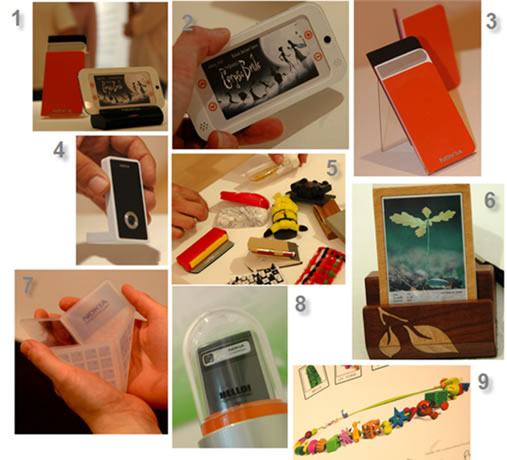
Nokia collaborated with Industrial Design students from Central Saint Martins College of Art and Design in London to come up with product concepts forecasting how people will use mobile technologies in 2015.

1 & 2 Ik-Soo Shin: “The aim was a user friendly product that gave an emotional relationship, like a friend. A new generation of mobiles with Artificial Intelligence will be able to express a user’s feelings, such as anger. The phone will also automatically recognize the voice of the user, allowing communication between them and their mobile”.

3 – Hannah Nuttal: “This phone is for those who do a blog and provides a fast, easy and more advanced blogging device. The phone has four layers, allowing for a multitude of functions and different methods of use. It can also be treated like a photo album, with images easily retreived, tagged and published on the blog”.

4 – Daniel Meyer: “The device was inspired both by the advent of video calling and the traditional practice of carrying pictures of family and friends with you. The handset is designed to sit as a picture frame wherever the user is, serving the dual purpose of communications device and a comforting familiar focal point at home, at work or when away”.

5 – Will Gurley: “Design your own phone. This is about stripping away technology and making your mobile phone more personal. You can chose a clear perspex case and put in it items that are individual and personal. Alternatively, you can buy attachments that say something about you, like a harmonica or a chess game”.

6 – Nicola Reed: “It aims to get people to be more green. It collects information on how much electricity and gas you use, how you get about, the type of products you buy and how you dispose of waste. It works on a reward system and you can earn free calls and texts by being environmentally friendly, like walking to work instead of driving”.

7 – Kimberly Hu: “The device works with the sense of smell, sight, hearing and touch. The user experiences communication on a multi-sensory level. It can detect, transmit and emit smell. It can also radiate colours, light and temperature from a caller’s environment”.

8 – Sung-Joo Kim: “People constantly upgrade mobiles and discard their old ones. In the future new mobiles will have to exist alongside older models that have become redundant in their primary role. This project proposes an afterlife for them, using secondary functions like the camera. This model allows old phones to become part of a CCTV network”.

9 -Jack Godfrey Wood: “Small, representational beads are exchanged instead of numbers. These are threaded on a necklace and to make a call you squeeze the bead of the person you want to call. Their bead will glow or vibrate. The electronics are in the clasp of the necklace, a microphone is worn as a ring and there’s a wireless earpiece”.

Very Intresting ! looks great 🙂

vivek

1 Comment

Designing Mobile phone Ui getting serious: what you want in a mobile phone

Its always being so exciting to see a great looking mobile user interface with an easy accessibility may be like an apple iphone, as most people like to pick up a new phone and they can carry out at least the basic tasks without reading the manual. Day by day a smartphones have become very smart and even mid-range phones have more functions in them than most non-technical people can cope with.  So do mobile company really thinks about a usercentric phones or its just a mean for increasing facilities !!! The time has come to make local search a core capability of mobile phones to help users discover both the functionality of the phone and the content that they store on it.

“Believeing that the design philosophy of existing mobile phone UIs is now seriously getting in the way of finding what you want on a mobile phone.”

I was reading an article and like the following below points

  • Many phone functions go unused – the UI is part of the reason
  • The handset UI is an important factor
  • New functions require new UI thinking
  • Advanced content and services exist but advanced service and content use still disappoints. 

Read article here

What you think? feel free to post your ideas here . .

vivek

1 Comment

Japan’s First time automatic picture Map conversion in Flash Lite

 FlashLite in japan, map

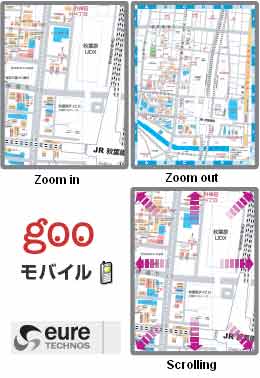
The popular version of Japanese portal “mobile goo” announced a free 3 months trial from 2007 July 18th to test new UI using Flash lite “Empowered by Euretechnos” image automatic conversion technology. It enables user to access exisiting maps conversion into Flash lite format that allows user to zoom in/out and scroll up/down. Goo claims to be the first to implement such technologies. This service works on 3G handsets with Flash lite 1.1

Seems cool!! It will be great if someone can post some comments & live screenshots.

Sources IT media

vivek

2 Comments

Critical Updates for Adobe Flash Player and Photoshop CS2\CS3 released

 Flash CS3 Professional, Dreamweaver CS3, Fireworks CS3

Adobe has released updates for its Flash Player and Photoshop CS2/CS3 software to fix holes that can be exploited by attackers, for instance to inject malicious code through specially crafted web pages or e-mail attachments.

“While an input validation error could lead to arbitrary code execution in Flash Player 9.0.45.0 and prior versions, insufficient validation of the HTTP Referer in Flash Player 8.0.34.0 and earlier versions might help attackers to execute cross-site scripting attacks. Another security problem related to the Opera and Konqueror browsers exists in Flash Player 7 (version 7.0.70.0) for Linux and Solaris, but Adobe does not provide more detailed information on this issue. The vendor advises users to upgrade to version 9.0.47, but also provides patches for other versions of the software.”

“The updates for Photoshop CS2 and CS3 fix the vulnerabilities detected by Marsu at the end of April. These can be triggered when manipulated BMP, DIB, RLE and PNG image files are handled, and could lead to arbitrary code injection and execution. A malicious image, e.g., from an e-mail attachment, must be opened in Photoshop in order to achieve this. Links to patches for Windows and Mac OS X are provided in the security advisory. The vendor advises users to install the update as soon as possible. ”

Reported by heise-security UK.

Download Flash Player update and read more
Download Photoshop CS2 and CS3 updates and read more

vivek

V4x Sequencer:the smart turnkey solution for producing mobile and interactive Internet channels supports Adobe Flash lite

V4x Sequencer

The newest version V4x Sequencer offers the ability to schedule and broadcast both live and pre-recorded materials for web and mobile TV channels. Interactive graphics from the latest Adobe Flashlite and Flash can be added in the V4x timeline to produce eye-catching mobile content.

Following feature are:

  • Create programs in record time; easy-looping
  • Build eye-catching shows with pre-set wizards
    and templates
  • Update with just one click
  • Auto-insert sponsor ads/logos as pre-rolls or transitions
  • Engage viewers with rich media and interactive graphics
  • Tag content for WEB 2.0 experience
  • Auto-stream H264, Flash Video, 3GPP; export podcasts
  • Effortless, background formatting for mobile and Web
  • V4x Sequencer requires minimal investment or staffing.
  • Add new revenue with exciting TV 2.0 content.

See demonstration video here
Download pdf here

It looks so easy just drag and drop of different media to make your own final content.
So lets ready with creative mind 🙂

vivek

user experience week 2007: shedule announced

user experience week 2007

This four-day conference introduces user experience practitioners to new rich internet application design approaches, practical prototyping techniques, effective cross-organization communications strategies and more.

With amazing set of spekers like, keynotes from Deborah Adler (Target pill bottle), Jan Chipchase (design research for Nokia), the $100 laptop interface design team, and our very own Dan Saffer. Other presenters include Jared Spool, Jess McMullin, Liz Sanders, Indi Young, Bill Scott, Leisa Reichelt, Derek Featherstone, Dan Brown, and a whole bunch of folks from Adaptive Path.

It includes some topic for mobile too:

  • Going Mobile: How to Choose Target Platforms and Devices? with Barbara Ballard, Little Springs Design
  • Mobile Usability Testing with Barbara Ballard, Little Springs Design
  • Mobile Research Techniques with Rachel Hinman, Adaptive Path

Time & Venue: Washington, D.C.—August 13-16, 2007
Read more and complete shedule details here

vivek