1 Comment

Adobe Fireworks an upcoming event for designers and Fireworks users, Bangalore, India

adobe fireworks cs4

Via Sarthak,  Adobe Fireworks team Bangalore organizing upcoming event for designers and Fireworks users, it will be exciting event to know the power of Adobe Fireworks CS4 public Beta and its new integration with Adobe Flex, PDF, Flash, Photoshop etc.

Details of the event:

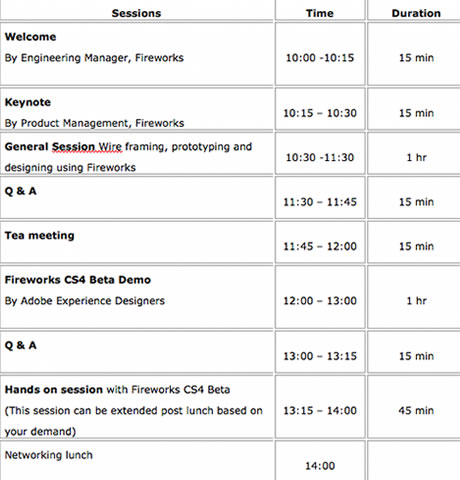
Adobe Fireworks CS4 public Beta bangalore event

Event time: Saturday 12 July 2008.
Time: 10 am to 2 pm
Venue: Adobe Campus, Bangalore

Please send a mail to “fwcs4bta@adobe.com” to confirm your participation.

you can also have a look on Adobe Fireworks Developer Center for new articles.
I will be there, let’s meet 🙂

vivek

1 Comment

Forum Nokia 2008 Code Camp Competition: Flash lite winners announced

Forum Nokia 2008 Code Camp Competition

Forum Nokia has announced the winners of the 2008 Code Camp Competition. The contest aimed at inspiring Forum Nokia Code Camp attendees to build Web Runtime (WRT) widgets and Flash lite applications.

The Winners are:

Grand Prizes
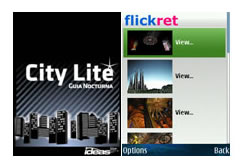
Flash: CityLite by MSCorp of Coral Springs, Florida. A mobile guide to night life, restaurants, and entertainment venues in Latin American cities.

WRT: Flickret from Mark Caunter of the U.K. A mashup that combines the Flickr photo-sharing application with MapQuest APIs to let users look for and get directions to places of interest.

Europe/Middle East/Africa
Flash: Kuneri Easy Vote from Kuneri of Oulu, Finland. One-button mobile voting lets users vote by mobile phone call, text message, or Web service.
WRT: Flickret from Mark Caunter of the U.K.

Americas
Flash: CityLite by MSCorp.
WRT: Fon11 by Mo’Blast of Berkeley, California. A mobile social-networking utility that lets users share their whereabouts with friends and family and determine if their contacts are nearby.

Asia-Pacific
Flash: WIND from Fieldsystem. This screen saver displays an image of a propeller turning in the wind. If the mobile signal is strong, the propeller spins quickly; if the signal weakens, the propeller spins more slowly. Also, the screen saver’s background scenery changes throughout the day.
WRT: Nutrition from Singapore Polytechnic. This widget is used for calculating your BMI and also calories burned on a daily basis, and it can help the user to check typical food nutrition in order to maintain a healthy life style.

China
WRT: Push To Speak from Beijing Motech Technology. This mobile travel guide to China helps tourists search for restaurants, places of interest, streets and more. Also, when the user clicks a word, the software “speaks” the word in Chinese, a useful feature for asking directions and instructing taxi drivers. The latest version includes information relating to the 2008 Summer Olympics in Beijing.

Congratulation to all winners 🙂

vivek
In Japan, Cellphones Have Become Too Complex to Use

japan mobile life

An interesting short report via Wired that people in Japan feel that phone become too complex with the features they have it. Japan may be in a culture of spec sheets. Where consumers go to electronics stores to buy a cellphone, they frequently line up the specifications side by side to compare them before deciding which one to buy. Some of the famous Japanese mobile companies are NTT DoCoMo, KDDI,  SoftBank and they make 5 % of global mobile phone sales, and rest all of those sales are just domestic.

  • Japanese handsets have become prime examples of feature creep gone mad. In many cases, phones in Japan are far too complex for users to master.
  • “There are tons of buttons, and different combinations or lengths of time yield different results,'” says Koh Aoki, an engineer who lives in Tokyo.
  • Experimenting with different key combinations in search of new features is “good for killing time during a long commute,” Aoki says, “but it’s definitely not elegant.”
  • Japan has long been famous for its advanced cellphones with sci-fi features like location tracking, mobile credit card payment and live TV. These handsets have been the envy of consumers in the United States, where cell technology has trailed an estimated five years or more. But while many phones would do Captain Kirk proud, most of the features are hard to use or not used at all.
  • “Some people care about quality, but first and foremost it’s about the features,” says Nobi Hayashi, a journalist and author of Steve Jobs: The Greatest Creative Director. He estimates that the average person only uses 5 to 10 percent of the functions available on their handsets.

The most important thing for any mobile company whether it is a product or services, is to provide unique user experience to end users.”Cellphones are now a days becomes an integral part of life “People are always using them and holding them, even in the middle of a meal anytime anywhere”.

vivek