Via Dale, another great video on “Flash Lite for the Digital Home” is the jumping point for application developers to move their existing skills and experience onto an entirely new screen – the TV! In this episode we outline the fundamentals of understanding Flash for TV, and some of the things developers will need to consider.
“I was completely blown away by this video the first time through. Such a simple, low-tech, solution produces such an amazingly rich, engaging experience that’s just bursting with possibility for further creativity.
While it’s just a concept at this point, you can see how it can make a new kind of storytelling available to the masses in a way that wouldn’t have seemed possible not that long ago.” via everydayux
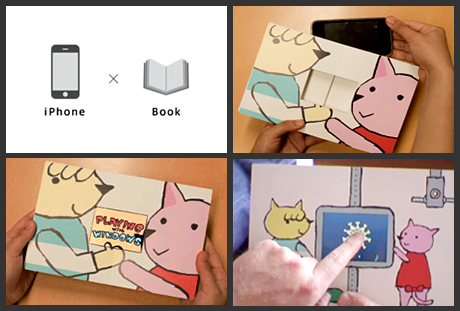
“It’s the hybrid book which combined iPhone and an ordinary book. Â You can enjoy interactive actions there, by touching the screen or tipping the book as you read it.”
“The keyword of Phone Book is “Analog on the Digital Technologyâ€; it combines digital value of iPhone and analogue advantage of books. This new approach will be able to apply to leaflet / catalogue for business use, art book, picture book or educational tool. It’s also possible to utilize ordinary movies / pictures instead of iPhone application.”
I’ve recently stumbled upon an interesting interface design by teamlab, the way they designed and looked into the natural dynamics of touch interface is amazing. I liked it personally very much such an amazingly rich, engaging experience that’s just bursting with possibility for further creativity. 🙂
“Actface†is a mobile device designed to create new contents using meta information of users behaviors.”
“Actface Rhythm is not a phone designed to produce music, but a phone that produces an internal rhythm, a moving image that is produced through the everyday use and the rhythm of pressing the keys. We regularly press keys to make a call, and to send a mail, and we considered this to be a natural rhythm. We designed actface Rhythm’s interface to produce an ink painting world that is created by the user, and as the phone is used the ink painting continues to develop and move with the rhythm you create.”
Via Mark, The LTE Connected Car is a platform for in-car entertainment, navigation, management and services. At MAX 2009 QNX won the mobile and devices award because of their excellence in working with the Flash Platform. Working with the geniuses at Alcatel Lucent QNX have enabled LTE connectivity (read: 4G) into the car to prep for a future of wireless networking at 100x the bandwidth of 3G (100Mbps in theory).
The platform interface is based on Adobe Flash Lite 3.1 running on the RTOS QNX platform with all manner of extensions for GPS, Bluetooth, video playback and even integration into the dashboard.
I hope people will have an awesome experience in the car with new interface design and your car will be always connected 😀
Via Alessandro, Dale Rankine has added a new video tutorial in his Developing with Flash Lite series, this is a simple checklist of some core performance optimzation techniques for helping to make your Flash Lite apps run as smooth as possible.
Dale has published another cool video: Â In this episode you will look at the ways Flash exists in various mobile browsers and what implications it has on how consumers interact with your Flash content.
It’s important as day be day more and more web traffic is being generated from smartphones and mobile devices, so it’s becoming increasingly important to consider how Flash content is consumed through the mobile web browser.